Weekly Media Links
From tax policy to coalition talks: the stories that matter this week
This week, Matt unpacks what was discussed at the latest political panels, why tax policy is shaping up to be one of the biggest election issues for rental housing providers, and what those changes could mean for the future of the sector. He also looks at the unintended consequences of current policy settings, explains how to get the most from your NZPIF Bunnings discount, shares fresh thinking on the changing housing market, and explores what a stronger showing from the Opportunity Party could mean after election day.

written by Matt Ball
20 July 2026
This week in 60 seconds
This week's stories in detail
Advocacy in Action
Two weeks ago, we had a political panel run by Wellington PIA and last week that was followed by Auckland PIA’s panel at their one-day conference. Great event by the way, well organised by Sarina Gibbon from APIA.
Again, there was good representation from all political parties, including National’s Carlos Cheung, the Greens’ Laurence Xu-Nan, Opportunity’s Holly Knill, ACT’s Simon Court and repeat appearances from NZ First’s Andy Foster and Labour’s Deborah Russell. I believe Deborah Russell is on Taranaki’s panel later this week!
Again, a (mostly) good-natured panel and lots of information imparted, like Wellington. What I want to focus on this week is tax, particularly Labour’s tax policy. Labour doesn’t see ‘property investors’ as businesses. In part that’s down to the name (Hipkins has said as much), and perhaps we should call ourselves rental housing providers instead.
Let’s be real though, the name is just an excuse. The big problem is that Labour see us as speculators who don’t contribute anything useful. They seem to have a blind spot for the fact that we provide homes for people to live in, we do work to maintain and upgrade those homes, and we even develop new homes. Good productive stuff.
Labour doesn’t see this and think we need to be taxed so that we don’t speculate, and so money currently put into housing goes into something ‘productive’ instead. That’s why interest denial (removing all or some interest deductibility) is still on the table. These two debates confirmed for me that Labour is going to bring back interest denial, they just haven’t decided the level yet or when they will announce it.
Reading between the lines, it seems like the decision on the rate will be made soon, but the policy won’t be announced until much closer to the election, and as part of their fiscal package. I’ve asked Deborah Russell if we can meet urgently – she’s open to that, I’ll just have to hope we can get in before the decision is made.
Unfortunately, Labour is stuck in the past. Interest denial (and Labour’s CGT) are remedies for an illness that’s no longer around. The housing bubble has been and gone. We’re now in an age of flat house prices and no windfall capital gains. Labour’s tax policies will do a lot of harm, with precious little benefit.
Corporate landlords vs 'mum's & dads' - what's best?
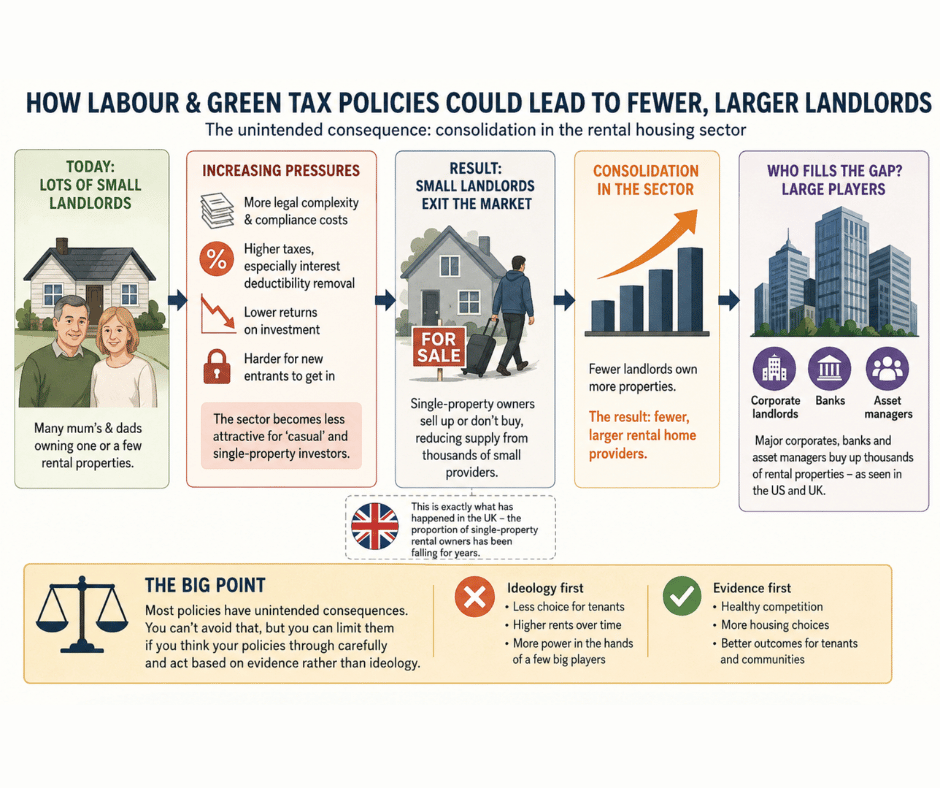
One of the perverse outcomes from Labour & Green tax policies towards landlords is that it’s likely to force out the smaller operators and lead to consolidation in the sector. Resulting in fewer, larger rental home providers. Here’s now it will happen.
Increasing legal complexity & compliance combined with lower returns make the sector less attractive to ‘casual’ property investors. Higher taxes, especially interest denial, will hit single-property leveraged rental owners harder, and will lock out new entrants. This is exactly what has happened in the UK where the proportion of single-property rental owners has been falling for years.
There are arguments on both sides as to whether this is a good thing, though it’s hard to imagine Labour/Greens want to create more ‘mega landlords’ as they like to call them! Another possibility is these policies create an opening for what’s happening in the US and UK, with major corporates, banks and asset managers buying up thousands of rentals. That link is to an Instagram clip from the “Diary of a CEO” podcast – worth a listen.
The point is this. Most policies have unintended consequences. You can’t avoid that, but you can limit them if you think your policies through carefully and act based on evidence rather than ideology. Enough said.
Bunnings discounts

Some of you will have received one or two emails from Bunnings about their new rewards scheme, one of which was sent in error and contains the wrong information for our members. If any of you followed the link that was in that email, you’d probably have got a message saying you’re not eligible for the new scheme as you are part of a buying group.
To reiterate, the discount that we get through our buying group with Bunnings far exceeds what’s on offer under the new rewards scheme, which is more aimed at retail customers who don’t have other options. What’s important though is to make the most of your NZPIF members discount, you need to sign up and use the PowerPass app.
Doing so will make shopping at Bunnings easier, and it’ll ensure you get the best discounts. Follow the instructions on the graphic below to sign up to the app.
More signs that the housing market has changed
I firmly believe that the housing market has changed because successive governments have promoted housing policy focussed on increasing housing supply. Without a major cock-up in housing policy by a future government, we’re not going back to the old days.
What’s interesting is that over the last couple of years this view has become increasingly mainstream. What caught my eye in the last week was an excellent column by Joseph Darby for Interest.co.nz which outlines this change. For fifty years, he argues, getting ahead meant a single trade: maximum leverage against residential land. He thinks this has changed, and there’s a new investment paradigm. I thought some of his comments were useful for property investors to bear in mind.
The first one relates to the family home, and this is a key point politicians ignore when making their special property investor taxes: owner-occupiers drove the property bubble too. They are two thirds of the housing market and were happily enjoying windfall capital gains along with everyone else. That’s changed. The old rule, that the family home is a wealth plan should, Darby argues, be replaced with “buy a home for shelter, security, and discipline when you can comfortably afford it.”
The second comment which I thought was perceptive and relevant, is about how property investing has shifted away from being viewed as a guaranteed return. As he points out, “Leveraged investing only manufactures wealth when an asset’s total return, meaning capital growth plus the income (rent, in this case) it earns or saves you, exceeds the interest cost of the debt.“ That’s not working so well in the current downturn.
But, it’s not all bad news: “Geared property can still win where the entry price is sharp, rent covers most holding costs, leverage is survivable, or the owner can add value through renovation or development, but it has become a business to run rather than a setting to default into.“
This is a really important point for our politicians to understand.
What happens if Opportunity gets 5% or more? Who will they work with?
Well, they have a plan for this. It’s important you understand it, because it changes the electoral calculus considerably, based on recent polls. Leader Quilae Wong told Stuff she‘d first call the leader of the party with the biggest share of the vote.
“We will go to that bigger party. We will push for our key policies which we think are the most important to take into a coalition,” she said.
She said Opportunity would enter into a period of exclusive negotiations with the largest party, about forming the next government. Only if those negotiations look to fail or stall would she then start talking to the other side.
I’ve underlined the key bits. It’s not ‘negotiate with both sides and take the best offer‘, it’s ‘negotiate with the largest party and only stop if you can’t reach a deal‘. Labour is the largest party; you can see where this is going. In my mind, that considerably increases the odds of a Labour-led coalition after this election.
Member Benefits That Make a Difference
Local Community
Connect with your local property investment community through monthly meetings, workshops, and events that offer networking and learning opportunities with fellow investors.
Strong Advocacy
Be part of a united voice that actively works with politicians, media, industry leaders, and government officials to influence policies and regulations that impact you as an investor.
Education Access
Enrol in RentSkills, our certificated education programme, to gain valuable insights to self-manage your properties effectively or optimise your relationship with property managers.
Exclusive Discounts
Enjoy special deals on services and products relevant to property investment – from credit reference checks to building materials, insurance, and more!
Weekly Media Updates
Stay informed with weekly member media updates providing the latest news and developments in the property investment realm.
Members-Only Resources
Unlock access to the Members Only area of our website, offering templates, resources, and forms like tenancy agreements.
Current Projects


Related Posts

Weekly Media Links Mon 19 October 2026
Weekly Media LinksIt’s been a busy week in housing politics, with ACT making a surprise promise to scrap rental loss ring-fencing and...

ACT adopts NZPIF ring-fencing proposal and goes further: a major advocacy win
ACT has announced it will campaign to remove rental loss ring-fencing for all residential rental properties, going further than the new-build...

Weekly Media Links Mon 12 October 2026
Weekly Media LinksThe new RMA is now law, a new meth testing standard is open for consultation, and tonight we’re putting housing...

Weekly Media Links Mon 5 October 2026
Weekly Media LinksProperty values have fallen for the sixth month in a row, but some parts of the country are telling a very different...

Weekly Media Links Mon 28 September 2026
Weekly Media LinksLabour’s decision to leave interest deductibility unchanged is still the big story for rental property owners,...

Weekly Media Links Mon 21 September 2026
Weekly Media LinksWhat a weekend! The 2026 NZPIF Property Investors Conference wrapped up in Tauranga with a packed programme of...
As featured on