Politics dominates this week's update, alongside growing media attention on housing and some encouraging economic news.
It’s a politics-heavy edition this week, but there’s more than election news. We cover our latest advocacy work, growing media coverage, and why there are reasons to feel cautiously optimistic about the economy.

written by Matt Ball
10 August 2026
This week in 60 seconds
- Politics dominates this week’s update, alongside growing media attention on housing and some encouraging economic news.
- Election politics takes centre stage this week, with housing, tax and the economy all making headlines.
- It’s a big week for politics, property and the economy, with plenty to unpack.
- From election tax policies to positive economic signs, here’s what mattered this week.
- A busy week of politics, property news and encouraging economic signals.
This week's stories in detail
Advocacy in Action
Talking to the Labour Party about Tax
Ahead of our meeting with Labour Revenue Spokesperson Deborah Russell, it was interesting to hear Chris Hipkins talk about ‘interest deductibility’ (interest denial) on Morning Report. He said Labour plan to release their policy on interest denial when they release their fiscal plan for the election. That could be late in the campaign period.
When asked if he considered it a new tax, he said no, “interest deductibility is currently a tax break that this current government has given to landlords“. It’s a bizarre logic they’ve talked themselves into.
Labour talks about interest deductibility as though National gave landlords something new. But, like every other business, landlords had been claiming interest as an expense for decades before Labour took it away. That’s like taking your neighbour’s lawnmower, giving it back two years later and then claiming you’ve given them a special gift. It’s bizarre. I think the problem is Labour see us as speculators, not businesses. We’ll test out that theory at our meeting next Monday.
Media content
Thanks to the election, media interest in housing stories has stayed high. In the last week we’ve been involved in this ZB story on Healthy Homes enforcement, this house price story by Miriam Bell, looking at how housing policies could affect long-term house prices, and this Stuff story by Janika ter Ellen, looking at two big tax policies which would shake the property market.
One policy is interest deductibility. The other is Opportunity’s land tax. As Janika points out, Opportunity “projects the policy would see house prices drop by 10-15%.” Ouch. More on that policy in the next story, but first one comment. We all want to see homes become more affordable; there are multiple social and economic benefits. But do it at a speed people can afford, don’t crash the market. Especially not straight after a boom.
Politics Corner: Opp, Opp and away
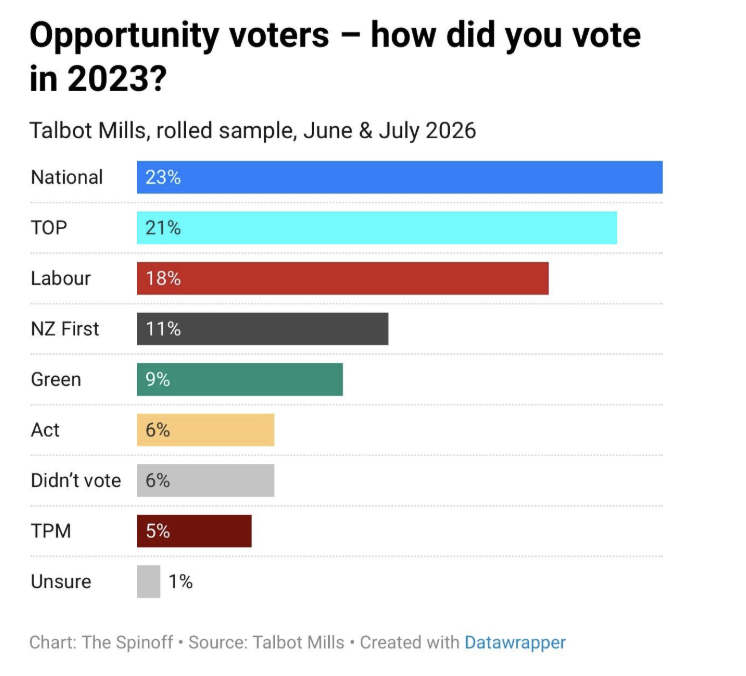
It’s happened. Opportunity (aka TOP) has passed the 5% barrier in a mainstream poll for the first time, hitting 6% in the Taxpayer Union-Curia poll last Friday. Interesting that this poll showed Labour at 27.8%, but for some weird reason there was no media hysteria about Hipkins’ leadership. No idea why. Luxon was most preferred Prime Minister too. Still nothing about Hipkins’ leadership.
Here’s an interesting thing. A few issues ago we talked about where TOP ‘s votes are coming from. The NZ Election Study data showed they mainly came from National & Green voters in 2017, Labour & National voters in 2020 and Labour & Green voters in 2023. However, a recent Talbot Mills poll reckons in 2023 TOP voters came mostly from National, followed by Labour, NZ First and the Greens.
I favour the NZ Election Study over Talbot Mills, and I think the Taxpayers Union-Curia poll backs that up: TOP’s rise seems to have come at Labour’s expense. Expect Labour to mount some vicious attacks on TOP. They’ve already called it a ‘rogue poll’.
Perhaps now’s a good time to look at TOP’s Tax Reset, which includes the Land Value Tax. Here’s what they’ve got to say about how this policy affects “Landlord Larry”:
“Under the Tax Reset, Larry would pay an extra $94,500 per year in tax, if he decided to keep his property portfolio.* Larry is doing what he does best. Making deals. He’s got half a dozen rentals he’s decided to unload, or else he’s going to take quite the haircut this financial year.
This new Land Value Tax has seriously changed the maths on his property portfolio. But Larry isn’t a guy to take things lying down. He’s onto his real estate agent mate to sell up a few places and he’s going into the development game on his biggest section – his developer mate reckons he could stick four townhouses on it and do well.
His stockbroker mate has a tip on a new agritech company going global out of Palmerston North too. If rentals aren’t the place for his dollars anymore, he’ll bloody well find another.
*A bit more about Larry – he makes $180,000 per year and has a residential property portfolio worth $6 million in land value.”
They’ve got a handy tax calculator, give it a go, see how you’d be affected.
I think what they’re trying to say is that rental providers will sell their least economically efficient rentals, redevelop some others, and perhaps keep the ones with a better return. I get that they want to destroy “the idea that the New Zealand economy should just be based on house price growth” as Chris Bishop said. TOP and National want the same things, but they’re going about it a different way.
I suspect there will be some unintended consequences. Landlord Lucy, for example, only has one rental property which the Land Tax now renders uneconomic. She’s been topping up the mortgage from her income as a nurse, which she can’t afford now, so she’s forced to sell. Unfortunately, she bought near the peak of the market and will take a financial hit. A comfortable retirement looks even further away. She’s gutted.
Tenants Tama & Tina, their son Tom & dog Toby, must find somewhere else to live, because they can’t afford to buy Lucy’s ex rental. If they can’t find a new rental locally, they’re all being sold. Tom will have to change schools. He’ll miss his friends. They’ll also have to come up with moving costs, an unwelcome addition to their already tight budget.
Will the tax become a reality? Maybe. It’s likelier if TOP goes with Labour than if they go with National, but they’d have to get a big vote share to have leverage. But hey, in the current topsy-turvy world, who knows. The latest Herald Poll-of-Polls has given Opportunity a 76.6% probability of entering Parliament, and in the ‘plague on all their houses’ mood of some voters, that seems highly credible.
However, the interesting thing is Opportunity getting into parliament benefits the centre-right more than the centre-left. If the centre-right are willing to work with Opportunity, they’ll have a 95.6% probability of being able to form a government.


Last word: The Economy, and why the oil crisis may not matter
The housing market’s still in the doldrums, but there are good economic signs despite global uncertainty, as outlined by the BNZ’s Mike Jones. Some sectors are doing well, especially agriculture and tourism, so despite high unemployment it does feel like we can be optimistic about the future. What’s interesting is that this is happening despite the war in the Middle East throttling oil supplies. Why would this happen?
One fascinating possibility, discussed in this Bloomberg podcast, is that the global energy market is adapting quickly and transitioning away from reliance on oil. This is especially the case for China, the world’s largest oil importer, which has been able to cut its imports by almost half. That’s quite an achievement. This adaptation has meant initial concerns about US$200 a barrel oil prices never materialised – we didn’t get close and oil is now around US$80 a barrel. Worth a listen if you have time.
That story lends weight to a recent piece from Liam Dann ($$ paywall), in which he argues that “New Zealand businesses (and the rest of us) need to adapt to this strange, unsettled world” we now live in. No more “survive till 25” or similar, which he says, “contributed to a damaging and negative mindset within the New Zealand business community.” A survival mentality. Instead, we just have to accept the new reality and get on with it. I think this is what’s happening, here and around the world. We’ve accepted the new reality and we’re adapting to it. Economic growth will follow.
Member Benefits That Make a Difference
Local Community
Strong Advocacy
Education Access
Exclusive Discounts
Weekly Media Updates
Members-Only Resources
Current Projects

Related Posts

Weekly Media Links Mon 19 October 2026
Weekly Media LinksIt’s been a busy week in housing politics, with ACT making a surprise promise to scrap rental loss ring-fencing and...

ACT adopts NZPIF ring-fencing proposal and goes further: a major advocacy win
ACT has announced it will campaign to remove rental loss ring-fencing for all residential rental properties, going further than the new-build...
Weekly Media Links Mon 12 October 2026
Weekly Media LinksThe new RMA is now law, a new meth testing standard is open for consultation, and tonight we’re putting housing...

Weekly Media Links Mon 5 October 2026
Weekly Media LinksProperty values have fallen for the sixth month in a row, but some parts of the country are telling a very different...

Weekly Media Links Mon 28 September 2026
Weekly Media LinksLabour’s decision to leave interest deductibility unchanged is still the big story for rental property owners,...

Weekly Media Links Mon 21 September 2026
Weekly Media LinksWhat a weekend! The 2026 NZPIF Property Investors Conference wrapped up in Tauranga with a packed programme of...
As featured on