Weekly Media Links
The headlines this week all point to one question: is the property market entering a new era?
This week we look at why flat rents might actually be good news in the long run, how NZPIF is helping shape the media conversation around rental housing, why Opportunity is becoming a party worth watching, and what a stock market crash nearly 40 years ago could tell us about the future of New Zealand’s housing market.

written by Matt Ball
27 July 2026
This week in 60 seconds
This week's stories in detail
Advocacy in Action
Media seem to be paying more attention to flat house prices and flat rents, and there are more stories appearing which examine whether property investing has changed, permanently. More on that one at the end.
On flat rents, 1News ran a piece about rent inflation being the lowest for 25 years, which included comment from NZPIF. Unfortunately, they haven’t posted the clip on their website, but this NZ Herald article covers the same points (paywall). If you don’t pay for the Herald, the key point is this: “Rents rose at their slowest rate, annually, in 25 years, according to Stats NZ. The country’s stock of rents rose by 0.5% between the June 2025 and 2026 quarters, continuing the trend of softening increases that began towards the end of 2024.“
While it’s not great for landlords who have been struggling with rising costs and can’t get a rent rise to cover it, when you look at the big picture, more affordable rents mean housing is less likely to be a political football. That’s good for us in the long term.
The other story we’re quoted in this week was one from Stuff, who obtained Cotality data showing that people who own more rentals were buying a smaller share of homes than rental providers with 10 propertis or less. While I think this is good and interesting data, it was missing a core component which would have provided even more useful insight. The numbers provided were the percentage of sales grouped according to how many properties the investors owned.
The problem with just having percentages is that the percentage of purchases by one group can go up or down even if the number of purchases stays the same. So, while it’s interesting that people who own more properties may be less active in the market now than people who own fewer properties, we can only speculate as to why. Which I did.
By the way, if you click the link you’ll see this headline: ” Mega-landlords sit on the sidelines as their share of home sales slump to seven-year low.” I hate the term ‘mega-landlord’, it’s emotive and designed to provoke a negative reaction – so I did have a grizzle to the journalist. Unfortunately (and I knew this already), journalists don’t write the headline, that’s up to the sub-editors, who write headlines so people will click on the story. It’s an essential part of the business (they need eyeballs to make money) and the sub-editors are good at it. That’s how media works. Felt good to complain though.
We will also be quoted in a story by Miriam Bell (Stuff) on RMA reform, for which she interviewed NZPIF president Peter Ambrose. Later this week we will appear in a Newstalk ZB story on Healthy Homes compliance.
A closer look at Opportunity
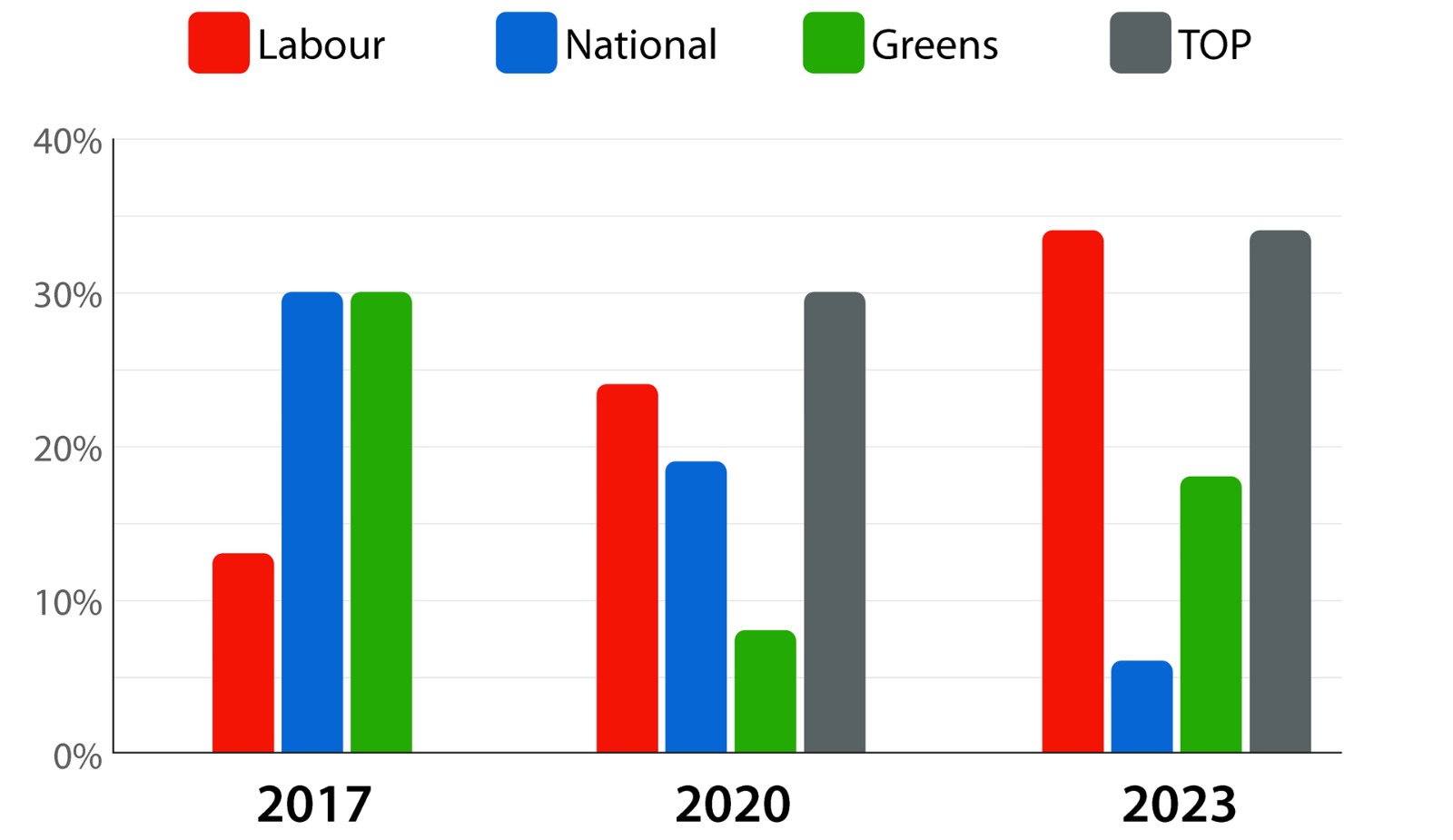
I came across this interesting piece on the Opportunity Party by Simon Wilson, and it’s worth a read. I don’t think Simon would object to me saying he’s a big old lefty, not least because he says he’s a Green voter. Just so you know where he’s coming from.
It’s worth a read for two reasons. One, it outlines why he thinks Opportunity (a.k.a. TOP) is gaining poll share, and he’s got some good points. He argues that Opportunity’s leader has pulled off the trick of making her party the answer to everything:
“You’re a greenie who wants a party that will work with National? TOP. You’re a libertarian disgusted by Act’s law-and-order numbskulls, and/or its climate deniers and gun lobbyists? TOP.
You want a high-wage economy but don’t think Labour has a clue how to achieve it? TOP. You want to honour the Treaty of Waitangi without honouring the nepotism of the Tamihere whanau? TOP. Maybe you support National but not when it extinguishes the pay-equity rights of women, or you want less poverty but not more government debt, or meaningful tax reform but not if it empowers Chloe Swarbrick: TOP.
And, most of all, if you want to put an end to the absurdity of 30 years of MMP in which we all vote and then Winston decides: TOP!“
That’s when he gets to his second point: Opportunity won’t get rid of Winston, because their votes aren’t coming from NZ First. Simon then supports his argument with what I think is his most useful information, Paul K. Gunson’s analysis of where Opportunity’s votes are coming from.
This shows that in 2017, TOP support was “drawn heavily from past National and Green voters.” In 2020 they retained a good chunk of their 2017 vote and got a good number of “Labour and National-origin voters.” In 2023, it looks like a fair few of those National voters went home, and TOP drew voters mainly from Labour and the Greens.
NZ First doesn’t feature as a vote source, and I think it’s the loss of the Green vote to Opportunity that Simon is worried about. But I think that analysis points to something else that could be equally influential: Opportunity attracts disillusioned voters. National/Green in 2017; Labour/National in 2020; and Labour/Green in 2023. This year they could get the ‘plague on all their houses’ vote – and that could be the decider in this election. Keep an eye on this as the campaign progresses.

Bond Data: Median rent still flat, two and a half years after the election
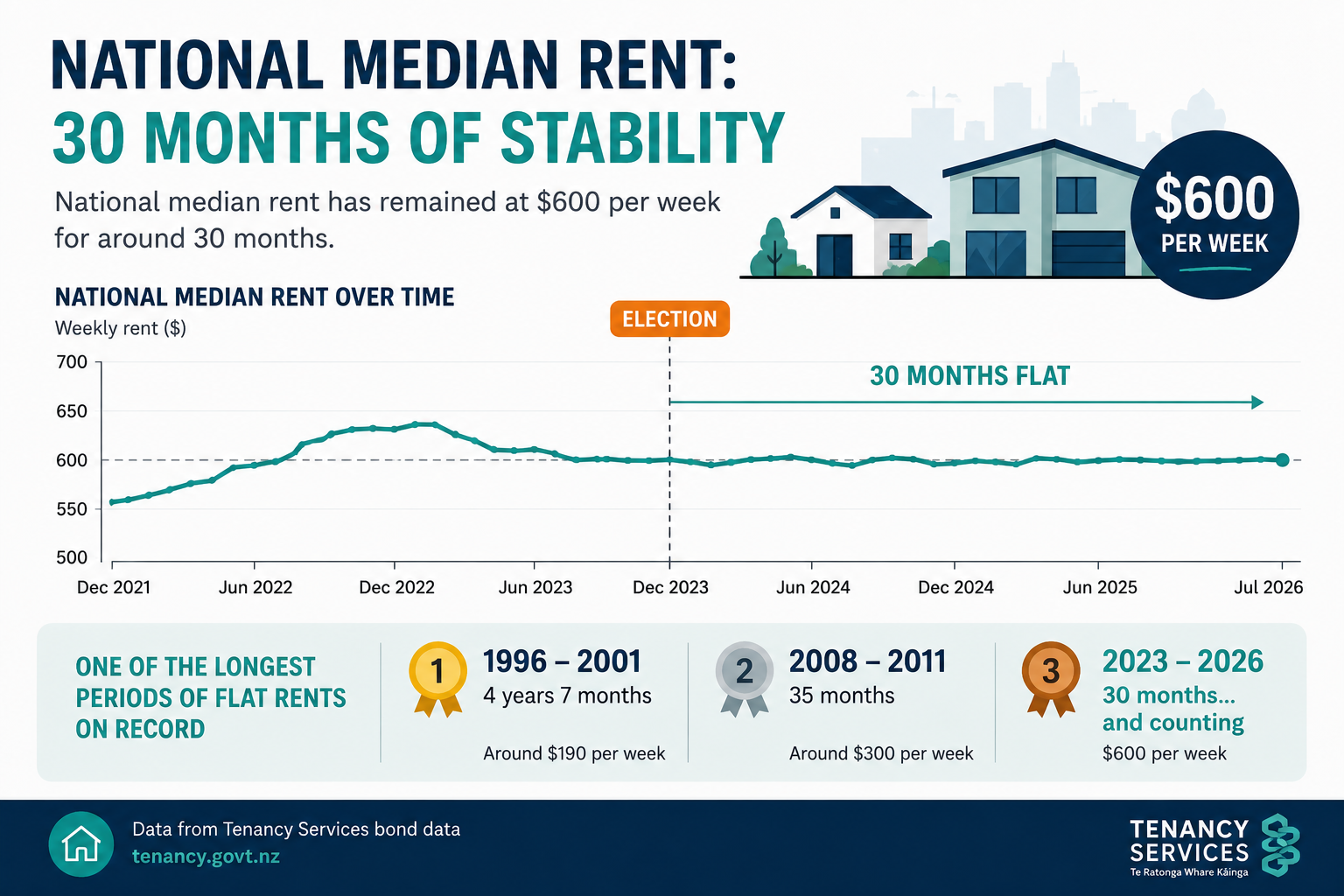
Different figures but related to the 1News story mentioned above. National median rent, as measured by bond data from Tenancy Services, remains at $600 per week, the same level it was at in December 2023. It has essentially been level (apart from a couple of blips up and down) for 30 months, or two and a half years.
That’s quite a long time, but that still only makes it the third-longest period of stable rents since 1993, when records started. If it stays flat for six more months (i.e. until after the election) then that will take it into second place, overtaking the GFC-related stable rent period when the national median rent sat at $300 for 35 months.
If you thought rent couldn’t stay flat much longer than that, well think again. The longest period of flat rents was after the 1996 election, when rent stayed stable at around $190 a week for four years and seven months. What will be interesting to watch is if national median rent starts to increase as we get closer to the election, as landlords nervous about the return of interest denial try to get ahead of the curve.
The '87 Effect – are we about to get the same in housing?
I came across this fascinating podcast from Craigs Investment Partners, looking at how the ’87 stock market crash shaped a generation of investors. It’s only 10 minutes long and well worth your time.
I was around for the ’87 crash, remember it well. I too bought Chase shares and lost the lot (IYKYK). I was working as a tiler at the time and the last job I did was for a firm that went bankrupt – never got paid. So that period had a big impact on me and loads of other Kiwis. What I didn’t realise was the true scale of our crash compared others.
While the US, UK & Japanese stock markets all crashed, it was only by around a third and they’d all recovered within two years. In NZ, we dropped by over 50% and didn’t recover for nearly a decade. That event was a major factor in thousands of Kiwis avoiding shares and investing in property to grow wealth and retirement security.
Hearing this story made me think: could the Covid boom & bust housing market have the same effect on this generation? It was described by Bloomberg as ‘The World’s Most Extreme Housing Boom’, and they concluded that New Zealand is a “tiny, but extreme” example of what happens when a housing boom goes into reverse.
I’ve been struck at how many people I cross paths with have a tale about how they bought a house or rental at or around the top of the market and are now sitting on a paper loss. Often with a large mortgage to feed. I’m curious to know how many people are sitting in negative equity and whether that number is large enough to have an “’87 Effect”.
Member Benefits That Make a Difference
Local Community
Connect with your local property investment community through monthly meetings, workshops, and events that offer networking and learning opportunities with fellow investors.
Strong Advocacy
Be part of a united voice that actively works with politicians, media, industry leaders, and government officials to influence policies and regulations that impact you as an investor.
Education Access
Enrol in RentSkills, our certificated education programme, to gain valuable insights to self-manage your properties effectively or optimise your relationship with property managers.
Exclusive Discounts
Enjoy special deals on services and products relevant to property investment – from credit reference checks to building materials, insurance, and more!
Weekly Media Updates
Stay informed with weekly member media updates providing the latest news and developments in the property investment realm.
Members-Only Resources
Unlock access to the Members Only area of our website, offering templates, resources, and forms like tenancy agreements.
Current Projects

Related Posts

Weekly Media Links Mon 19 October 2026
Weekly Media LinksIt’s been a busy week in housing politics, with ACT making a surprise promise to scrap rental loss ring-fencing and...

ACT adopts NZPIF ring-fencing proposal and goes further: a major advocacy win
ACT has announced it will campaign to remove rental loss ring-fencing for all residential rental properties, going further than the new-build...
Weekly Media Links Mon 12 October 2026
Weekly Media LinksThe new RMA is now law, a new meth testing standard is open for consultation, and tonight we’re putting housing...

Weekly Media Links Mon 5 October 2026
Weekly Media LinksProperty values have fallen for the sixth month in a row, but some parts of the country are telling a very different...

Weekly Media Links Mon 28 September 2026
Weekly Media LinksLabour’s decision to leave interest deductibility unchanged is still the big story for rental property owners,...

Weekly Media Links Mon 21 September 2026
Weekly Media LinksWhat a weekend! The 2026 NZPIF Property Investors Conference wrapped up in Tauranga with a packed programme of...
As featured on