50 days to go: rates, reform and a changing housing market
Spring’s here, the election is less than 50 days away, and there’s still plenty we don’t know about what it could mean for property investors. Meanwhile, the OCR has gone up, house prices remain subdued and the economic recovery is looking very different depending on where you live. Here’s the quick version of what matters this week.

written by Matt Ball
7 September 2026
This week in 60 seconds
- Election uncertainty continues: Labour is yet to release its interest denial policy, and we may not see it until October, despite voting beginning on 26 October.
- We’re meeting the Housing Minister: NZPIF meets Chris Bishop this week to talk housing, progress on the Government’s programme and where we think further reform is needed.
- Bond problems: We’re continuing to help members resolve missing and problematic bonds. If the usual channels aren’t getting you anywhere, Kathryn Seque-Roche can help.
- OCR up to 2.75%: The Reserve Bank raised the OCR as expected, but its softer tone suggests the next increase may not come until December or even 2027.
- House prices staying flat: Cotality recorded a fifth consecutive month of falling property values, while the Reserve Bank expects prices to remain broadly flat for another few quarters.
- The South is leading the recovery: Queenstown topped Kiwibank’s regional economic rankings, followed by Southland and Otago. Taranaki and Wellington remain among the weaker regions.
- Investors like Queenstown too: Tony Alexander’s latest investor survey put Queenstown at the top of the list of places investors would buy next, followed by Southland, Canterbury and Bay of Plenty.
- Keep an eye on RMA reform: It may not make the loudest headlines, but the work happening in Parliament could make developing and improving property easier and cheaper. Potentially a very big deal for investors.
- National’s first-home buyer policy: National wants to expand access to 5% deposit First Home Loans by lifting the income cap to $300,000. It could bring more buyers into the entry-level market and have some interesting knock-on effects for investors.
This week's stories in detail
Advocacy in Action
Meeting the housing minister this week
We’ve got a meeting with Housing Minister Chris Bishop this week, where we’ll discuss the big picture around housing, the success or otherwise of the coalition’s programme to date, and our ideas for further policy reform for the sector. We’ll update next week.
Help with sorting out bonds
After our success with getting help from Associate Housing Minister Tama Potaka to retrieve lost bonds (Media Links 31 Aug), we’ve had a steady flow of problems reported to us and have continued to work with officials to get them resolved. No, it’s not good that there are these problems, but it is good that we have open channels of communication and are able to get problems sorted out. It’s one of the key reasons we exist as an organisation, to help our members and advocate on their behalf.
Vice President Kathryn Seque-Roche has become somewhat of an expert in this area and she’s still happy to give advice or take cases to officials as appropriate. If you’re having trouble with a lost bond or something similar and aren’t getting any joy through regular channels, drop her a line at [email protected].
OCR decision
As expected, the RB put the OCR up to 2.75%, but a more dovish statement from them has led economists to think that there’s less certainty of a hike in October, with it potentially being December or early 2027 before we see the OCR at 3%. Some good commentary in this short podcast from Cotality, who described the RB’s tone as “we have raised rates today, but we are not on a predetermined path. It could be December or next year for the next move. It might only be one or two more rises over the next year or so, so there is no reason for mortgage holders to panic.” That’s a good message.
They also noted that the “Reserve Bank’s detailed forecasts for house prices are broadly flat for the next three or four quarters before some growth re-emerges late next year.” So potentially another year of house prices growing more slowly than inflation and wage growth, not great if you’re looking to sell, but good for affordability. Cotality’s Housing Value Index, out last week, showed values easing for the fifth month in a row.
As an aside, it’s worth reading this section of the Reserve Bank’s Monetary Policy Statement. It’s under Chapter 4, special topics, the section about recent developments and the outlook for household consumption. I can’t link directly to it, but it looks at the reasons behind their house price forecast and the impact of that on the economy.
The good news is that there are more signs the economy is picking up, with the South leading the way. According to Kiwibank’s latest regional score update Queenstown has topped the rankings with a score of 9 out of 10, followed by Southland and Otago (7) – while Taranaki (3) and Wellington (3.4) sat near the bottom of the table.
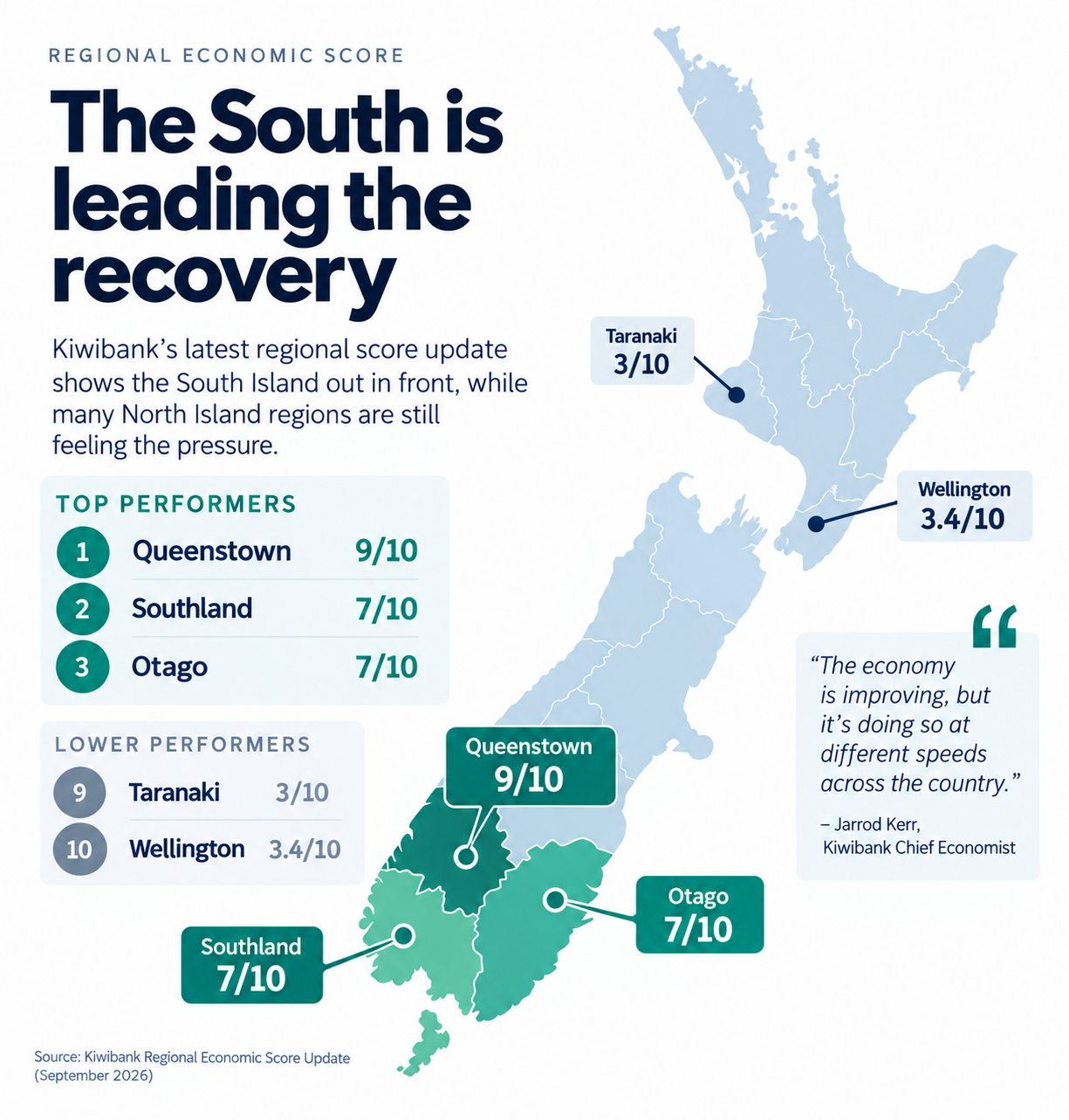
It’s interesting how this was reported. On RNZ, it was all doom and gloom: “Why the economic downturn keeps dragging on – and the regions doing the worst.” Not even a flicker of optimism. Meanwhile over at the Herald, it was “Economic recovery spreading from the south.” Must be miserable working at RNZ.
Anyway, the actual report was mixed, as KB Chief Economist Jarrod Kerr said, “The economy is improving, but it’s doing so at different speeds across the country.”
Tourism-heavy and agricultural regions in the South Island were leading the way, while many households and businesses in the North were still feeling the pressure of weak demand, higher costs and economic uncertainty. Queenstown remains the standout.
Not surprising then that when Tony Alexander surveyed investors about where they’d buy another property, Queenstown was at the top of the list. Southland, Canturbury & Bay of Plenty were the next three. Make of that what you will.
The quiet work you need to pay attention to – RMA reform
Not everyone at RNZ is feeling sad, thankfully. Here’s a nice piece by Phil Smith on how the RMA reforms are progressing through parliament. If you read anything from here this week, this article is my pick, because it’s an insight to the real work that Parliament does, not the shouting and point-scoring of Question Time. Which is all just theatre.
Phil describes how “a clutch of MPs from across the House, who specialise in planning and environment law, spent achingly long days considering the minutiae of two bills designed to replace the Resource Management Act. Its consideration – from both sides of the House – was dedicated and careful, professional and informed, unemotional and earnest.”
He mentions four opposition MPs who were crucial to the process: “Rachel Brooking and Arena Williams for Labour, and Lan Pham and Steve Abel for the Greens.” Then two key government members, National’s Minister for RMA Reform Chris Bishop, and his associate ACT MP and Parliamentary Undersecretary Simon Court who both “kept things constructive and even at times cheerful, which is quite a feat during such long days.” The house sat under urgency for three 13-hour-long days.
I’ve highlighted this article partly to show the positive side of how parliament works, which I think is important to understand and is often overlooked, but also because the RMA reform is such a significant change. If it works well – and this process gives me hope it will – then this will have a major impact on property investors right around the country.
It should become easier and cheaper to develop and improve your property, creating an opportunity to increase cashflow, add to capital value, and create wealth – all the while adding to and improving the housing stock, which of course is a great benefit to renters.
Do keep an eye on this work and have a think about how it will affect you, your current holdings and future plans.
An interesting housing policy from National
Campaigning is in full swing and policies are coming out thick and fast. One from National caught my eye today, their plan to expand the First Home Loan scheme by raising the income cap to $300,000. The aim is to let more people who can service a mortgage buy a home with just a 5% deposit. This could double the number of first-home buyers using the scheme. What could this mean for property investors?
We shouldn’t expect a massive tenant exodus or a rental vacancy crisis. High-income renters making up to $300,000 are a small slice of the tenant pool, but if you cater to that market, it could affect you. There could be a localised shuffle in premium rental pockets, and perhaps a bit more competition for modern townhouses or standalone suburban builds.
Another potential impact is a “price floor” effect on entry-level properties. When you hand thousands of buyers 95% leverage, they may use that extra buying power to outbid one another, pushing entry-level asset prices up. That happened with a similar scheme in Australia recently. Investors with ‘entry-level’ property could find themselves with a government-backed house price lift.
It’s all theory, but it’s important to look for the unintended consequences of party policies. If you find the thing no-one else thought of, you could be a winner.

Member Benefits That Make a Difference
Local Community
Strong Advocacy
Education Access
Exclusive Discounts
Weekly Media Updates
Members-Only Resources
Current Projects

Related Posts

Weekly Media Links Mon 19 October 2026
Weekly Media LinksIt’s been a busy week in housing politics, with ACT making a surprise promise to scrap rental loss ring-fencing and...

ACT adopts NZPIF ring-fencing proposal and goes further: a major advocacy win
ACT has announced it will campaign to remove rental loss ring-fencing for all residential rental properties, going further than the new-build...

Weekly Media Links Mon 12 October 2026
Weekly Media LinksThe new RMA is now law, a new meth testing standard is open for consultation, and tonight we’re putting housing...

Weekly Media Links Mon 5 October 2026
Weekly Media LinksProperty values have fallen for the sixth month in a row, but some parts of the country are telling a very different...

Weekly Media Links Mon 28 September 2026
Weekly Media LinksLabour’s decision to leave interest deductibility unchanged is still the big story for rental property owners,...

Weekly Media Links Mon 21 September 2026
Weekly Media LinksWhat a weekend! The 2026 NZPIF Property Investors Conference wrapped up in Tauranga with a packed programme of...
As featured on