Housing policy, rental supply and where the opportunities are shifting
This week, NZPIF takes its concerns and policy ideas directly to Housing Minister Chris Bishop, including tax settings, enforcement and Tenancy Tribunal funding. We also look overseas at what’s happening as UK landlords exit the rental market, unpack the Government’s new Golden Visa Build-to-Rent policy, and head south, where a stronger local economy is creating demand for rentals and new opportunities for investors.

written by Matt Ball
14 September 2026
This week in 60 seconds
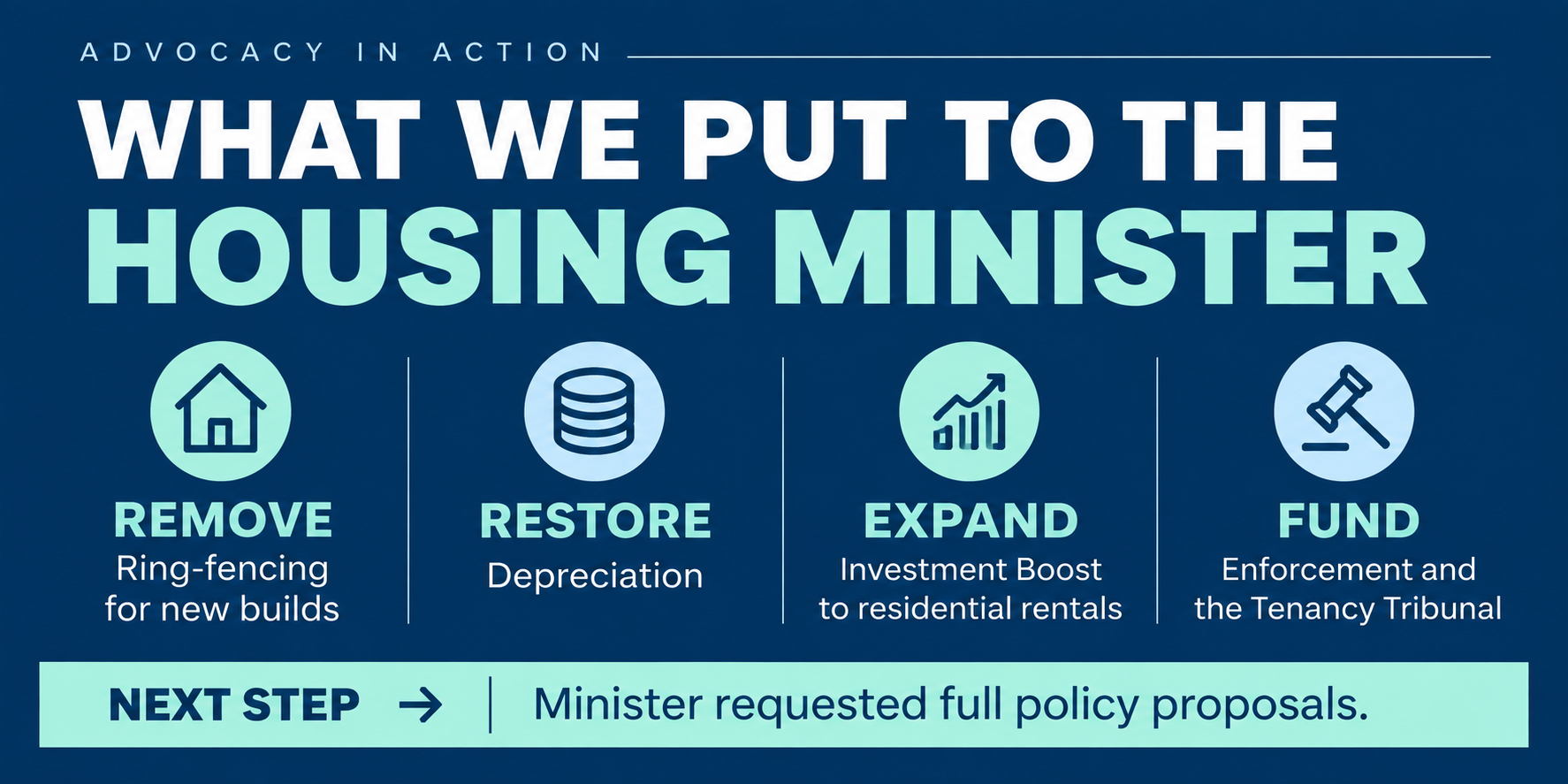
- NZPIF meets Chris Bishop: NZPIF put forward proposals including removing ring-fencing for new builds, restoring depreciation and extending Investment Boost to residential rentals. The Minister has asked for full policy proposals.
- Enforcement over more regulation: NZPIF argues that funding existing enforcement could achieve more than adding new rules, including the proposed boarding house register. More funding for the Tenancy Tribunal is also on the wish list.
- A warning from the UK: Large numbers of UK landlords are selling, putting pressure on rental supply and housing courts. NZPIF sees it as a cautionary tale about the unintended effects of rental regulation.
- Golden Visa money heads towards rentals: From December, Active Investor Plus funds can flow into approved Build-to-Rent investments. With $5 billion already attracted through the scheme, it could eventually provide a sizeable boost to new rental supply.
- The south tells a different story: Stronger economic activity and worker demand around places such as Twizel are encouraging some owners to switch short-term accommodation into long-term rentals, showing just how closely rental markets follow local jobs and incomes.
This week's stories in detail
Advocacy in Action
Meeting with housing minister Chris Bishop
Another good meeting with a key political leader. Some would say the key politician as far as our sector is concerned. Bishop has been the driving force behind many of the reforms aimed at increasing housing supply, and which are transforming the housing and rental market.
First, we gave him an update on the rental sector, how things are going around the country. We noted that the changes to the Residential Tenancies Act, and restoration of interest deductibility were welcome, as are the supply-side changes to the housing market. However, we feel that these changes are in the process of transforming the sector, with less reliance on ‘windfall’ capital gains and more reliance on cashflow & building value.
That in turn leads to the need to normalise tax policy toward our sector, so that we are treated like other businesses. Many of the taxes imposed on property investors were at a time when the housing market was overheated and government used the tax system to try to stop investors buying houses, instead of addressing the supply-side problems.
That’s changed, so the system needs to change. We outlined NZPIF’s policy proposals in this regard:
- Removing ring-fencing for new builds
- Restoring depreciation
- Expanding Investment Boost to cover residential rentals (like the Labour policy), potentially target at upgrades to Healthy Homes & economic efficiency, eg double glazing, solar etc.
He did not reject any of these ideas and asked us to send full policy proposals covering each point, which we will do. We’ve promoted these policies to both Labour and National and will continue to lobby for them post-election.
Another point we put forward was the value of enforcement over regulation. Our view is that better enforcement is preferable to too much regulation. One of the trends that worries us is how regulation is usually the first response to a problem, rather than dealing with the problem using existing tools, which are often not well used.
As an example, the proposed boarding house regulation bill, which seeks to register boarding house owners, but contains no additional mechanism for monitoring standards or enforcing them. Would creating a register actually achieve anything?
Our argument is that it wouldn’t, that enforcement would still be needed, and that in fact the money spent on creating and maintaining a register would be better spent on beefing up existing enforcement channels. We estimate a register would cost around $2-3million a year to operate – we have suggested to both housing ministers (Bishop & Potaka) that this money would be better spent by TCIT (Tenancy Compliance & Enforcement Team).
There is a strong self-interest in this for us. Bad landlords and bad boarding house owners cause harm – and they make the news. That creates an anti-landlord sentiment, which undermines the work of the majority of landlords who do a good job. It is also the driving force behind calls for more regulation. Our view is that instead of tying up law-abiding landlords in red tape, it’s better to target the ones who are breaking the law.
Finally, we made an argument for more Tenancy Tribunal funding. Wait times are still too long and while the initial results of the pilot to fast-track rent arrears are promising, there’s only so much they can do within existing funding. Increasing TT funding, by even relatively small amounts, could have an outsize benefit for tenants & landlords.
We only had half an hour with the Minister, so weren’t able to get all our agenda items covered in the one meeting. We will raise other matters, especially relating to the new pet laws, in a follow-up letter. He’s also coming to conference, so that’s another chance to discuss things with him.
The UK rental market's a mess. I wonder why...?
How’s this for a headline: “England’s housing courts at breaking point as renters battle no-fault evictions.” You’d think the poor renters were suffering because landlords were turfing them out for no reason. But there is a reason.
The sub-headline hints at the real story: “Courts said to be ‘overloaded’ as landlords sell properties and tenants with nowhere to go try to delay evictions.” The Labour government in the UK brought in the Renters Rights Act, which removed no-fault terminations and made life hard for private landlords.
So, what did they do? They’re getting out. Selling up and leaving. Check out these stats: Over a quarter of a million “buy‑to‑let homes” (the ‘mum & dad’ investor in the UK) were listed for sale in the year to March 2026, a 28% increase on two years ago! About 93,000 landlords sold up in 2025, a further 110,000 are forecast to go in 2026. There are more landlords in the UK than here, but that’s still a ton, and surprise surprise, it’s hitting renters hard. Especially in London, where former rental properties account for 30% of all new sales, compared with 13% across the rest of the country.
It’s a sad story. Politicians enacted some terrible laws wanting to help renters but made them suffer instead. The reason why is cleverly explained in this recent article by Damian Grant in Stuff. He talks about Ceteris Paribus: “all things being equal”. Meaning, policy is devised assuming nothing else changes. But things do change, especially when taxes and regulations are concerned. Landlords/property investors don’t sit still and take the punishment. Housing isn’t the only investment in the world so if Government makes it too hard, we leave.
Those who promoted this UK law change are so blinded by ideology they can’t see the damage they’ve done. The Generation Rent spokesperson (our Renters United) said “the fact so many landlords uprooted tenants’ lives just because they still could, shows how badly we needed greater protections and the end of section 21.“
Mate, landlords didn’t do it ‘just because they could’. The law made it too hard to be a landlord, and they wanted to get out before they went broke. Well-meaning politicians caused this calamity.
The reason I’m covering this is because what’s happening in the UK is what will happen here if we get a Labour/Green/TPM government. The Greens even want to “implement a Renter’s Rights Bill.” Vote accordingly. Make sure your tenants know the danger too.
Another interesting policy – Golden Visa Build-to-Rent Boost

From December this year, wealthy migrant investors will be allowed to put their money into approved managed funds that finance Build-to-Rent housing. Applicants for the Active Investor Plus (Golden Visa) Growth category must commit a minimum of NZ$5 million for at least three years. It’s all about increasing housing supply. When announcing this change, Chris Bishop said that “New Zealand needs more homes of all kinds, including more long-term rental homes that are purpose-built for renters”.
The policy works as a supply-side stimulus aimed at building new, large-scale rental communities rather than stoking competition for existing standalone homes.
What’s the impact on property investors? The Golden Visa scheme has already attracted NZ$5 billion across more than 900 applications, so even a modest diversion of these funds into housing could inject hundreds of millions into new construction pipelines. Simplicity Living is already planning to use golden visa money to fund its projects.
However, this increase in supply won’t appear quickly because of the time it takes to plan and consent such developments. Any shifts in rental supply dynamics will likely materialise gradually over the next three to five years.
While we’re on policy, I see that Nadine Higgins noticed the same thing I did about National’s changes to the income cap for First Home Loans. That, as we mentioned last week, it could increase prices on entry level homes. She thinks it’ll have a stronger effect than I do, but the principle is the same. Good to see I’m not the only one looking behind the policies.
We want to hear from you: How do you see the expansion of institutional build-to-rent funds impacting your local rental market? Send your thoughts and feedback to [email protected] so we can represent your voice in upcoming policy discussions.
Perhaps the economy is important after all
I found this story from Twizel interesting, in that it sums up why the housing and rental market in the south is doing better than the north. It’s all about the economy, and honestly, it’s a great story to read. In short, the Mackenzie district seems to be doing well economically, creating a bit of a shortage of accommodation for workers.
That in turn has led some property investors, like Christchurch resident Ryan Stratford quoted in the story, to turn their AirBnB properties into rentals for people working for local businesses like High Country Salmon. It’s gone so well for Ryan he’s now looking for more property to buy.
I do feel like it’s a simple story and one that’s also relevant for areas like Auckland and Wellington where house prices and rents are flat. If people have jobs, if they can earn more money, they can afford to pay more for better housing. I’m not saying another property price boom is on the way, I think there’s too much housing supply for that. But a better economy will create more opportunities to lift earnings and profit.
I’m optimistic that, with a good election result, we will see the Auckland and even Wellington economies pick up in 2027. Yes, I know we’ve been here before, but the signs are much more widespread and underpinned by solid economic fundamentals. It’s worth keeping an eye out for good opportunities in your area and making sure you’re ready for when the upturn comes.

Member Benefits That Make a Difference
Local Community
Strong Advocacy
Education Access
Exclusive Discounts
Weekly Media Updates
Members-Only Resources
Current Projects

Related Posts

Weekly Media Links Mon 7 September 2026
Weekly Media LinksSpring’s here, the election is less than 50 days away, and there’s still plenty we don’t know about what it could...

Weekly Media Links Mon 31 August 2026
Weekly Media LinksPlenty is happening in property this week. NZPIF takes concerns about missing bonds straight to the Associate Housing...

Webinar : Election 2026: what could the next government mean for property investors?
Election 2026: what could the next government mean for property investors? With the election approaching, housing and rental policy is firmly back...

Weekly Media Links Mon 24 August 2026
Weekly Media LinksThis week we’ve been talking directly with Labour, Renters United and Opportunity about the policies that could shape...

Weekly Media Links Mon 17 August 2026
Weekly Media LinksA week sure is a long time in politics! Did not expect that when I signed off last week. I'm sure you're all heartily...

Weekly Media Links Mon 10 August 2026
Weekly Media LinksIt's a politics-heavy edition this week, but there's more than election news. We cover our latest advocacy work,...
As featured on