Falling house prices, more building and the CGT question
Property values have fallen for the sixth month in a row, but some parts of the country are telling a very different story. We take a closer look at Labour’s CGT numbers, where the property market could be heading next, and why residential construction is starting to pick up again. Plus, an update on pet bonds, our ring-fencing work and next week’s housing debate, which we’ll be live-streaming.

written by Matt Ball
5 October 2026
This week in 60 seconds
- Property values fell again: Down 0.3% in September and 1.3% over the past year. But look back 10 years and the picture changes quite a bit depending on where you own. Pasted text
- Will Labour’s CGT bring in what it expects? The numbers can work, but slower house-price growth could mean less tax coming in, particularly in the first few years. Pasted text
- More homes are being built: Residential construction rose 4.4% in Q2 and consents are up 21% on a year ago. Canterbury, Otago and Auckland are leading that growth. Pasted text
- We want Auckland examples: Got a development that could stack up better if ring-fencing was removed for new builds? Matt wants to hear from you. Pasted text
- The housing debate is going live: Next Monday, representatives from National, Labour, ACT, NZ First and Opportunity will face questions on housing and the rental market. We’re livestreaming it from 7pm. Pasted text
- Pet bonds: Thanks for all the feedback. Overall, there was support for allowing up to four weeks’ pet bond, and those views are now being taken to political parties.
This week's stories in detail
Ring Fencing Policy Help
Are you based in Auckland? Do you have a property development underway, or planned, which would be helped by our policy to remove ring-fencing for new builds?
If so, I want to hear from you. We need to promote this policy and we need examples of how it would help increase rental supply, support construction and encourage people to invest in the rental sector – landlords of the future.
If you have a project you think would be a good example of this policy in action, contact Matt Ball at [email protected].
Property values fall for the sixth month running – what's the full story?
Cotality NZ’s latest Home Value Index (HVI) fell -0.3% in September compared to August, the sixth monthly fall in a row. National property values are now -1.3% lower than a year ago. That’s what you would have read in the headlines, but there’s more.
Chief Property Economist Kelvin Davidson said, “the focus on value falls since the market peak should be balanced against longer-term trends,” which is a good point. Although we shouldn’t forget the post peak impact, so I’ll look at that first.
According to Cotality, there were around 83,000 property transactions during the Covid peak (H2 2021-H1 2022). Yes, that’s a small number compared NZ’s total dwelling stock, but it’s a ton of households now potentially in negative equity. I think you could reasonably add in the transactions for H2 2022, given the median price is now below what it was in Dec 2022. And that’s not accounting for inflation.
Let’s say that’s maybe 120,000 households, maybe 250,000 people. Mostly in Auckland and Wellington. Not seeing their house value go up, in fact seeing them go down, while interest rates are heading up. That’s an economic pinch right there. A quarter of a million grumpy voters. That’s enough to turn an election.
What about over the longer term? Well, that’s also interesting. “Over the past decade, national property values have increased by an annualised rate of 3.2%, with 16 markets recording average annual growth of at least 7%,” Cotality said in their release.
Over the past decade, inflation has had a 3.3% compound average annual rate (StatsNZ inflation calculator), so national house values have done ok. Homes held value. Those 16 markets with growth of at least 7% are the real winners tho. Who was the loser? Auckland. Grew only 1.2% a year. Auckland houses are getting cheaper in real terms.
All the other main centres – even Wellington (!) – beat inflation. Some regions saw average annual growth of over 8%!
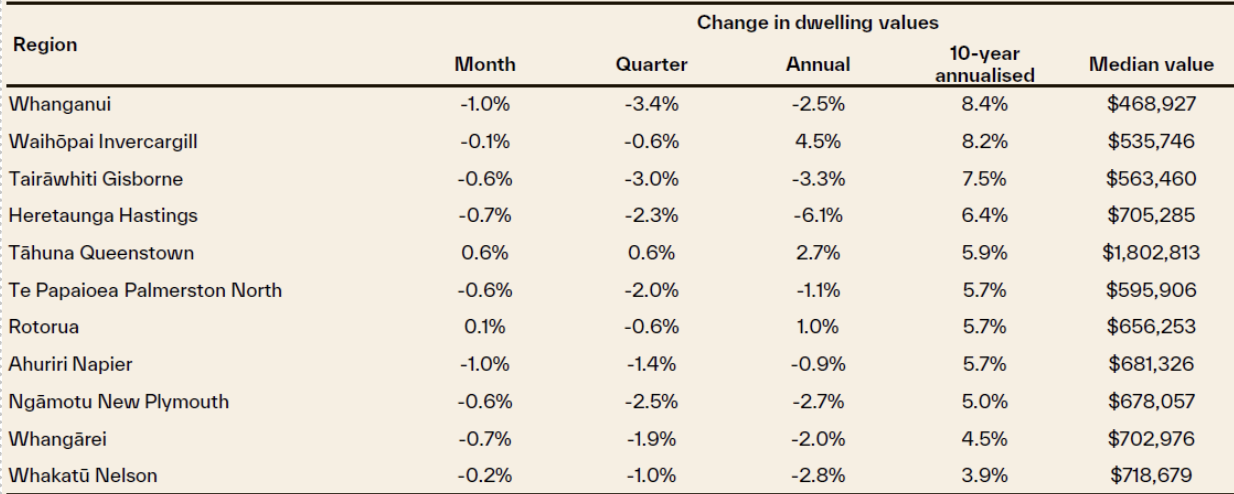
That’s all good, but it’s the past. What of the future? Where to buy now to get these numbers in 10 years’ time? Davidson’s view is that “current conditions are unlikely to support a sharp rebound in prices.” Fair. He adds that until “labour market conditions and job security improve more meaningfully, sustained house price growth appears unlikely.” I’d agree. And, if Labour wins, their CGT will add to the drag on the market.
With all of that weighing, I’d look to economic fundamentals when considering where and what to buy next. As Davidson notes, “many of our regional centres, especially in the South Island, are seeing decent economic growth on the back of tourism and farming, with spillover support for their housing markets too.”
Follow the money. Better still, anticipate it. Some regional centres are already doing well – where’s next?
Pets, pet bonds, and your views
Pets continue to be a topic of conversation that gets people fired up! Thanks for all the feedback on the idea allowing up to four weeks pet bond to be charged. As usual, there was a range of views though it’s fair to say that on balance the idea received support.
Some think it will never be enough for the worst cases of pet damage, which is probably true. Others think it’s not a big deal. Most were in the middle. A lot depends on people’s past experience with pets, which is totally understandable.
We’re collating the feedback and will send it to various political parties to get them to consider adding to their policy platforms.
Will Labour's CGT raise any money?
This is a question many are asking, including media, and especially after PREFU.
Labour’s CGT numbers are based on house prices increasing by 3% a year. For the first year of the tax they’ve assumed a lower number, presumably to account for seller behaviour and a more subdued market. Labour considered that a conservative approach when they released the policy last year – but back then Treasury was forecasting house price growth of over 5%. Things have changed.
I did some initial analysis of Labour’s numbers, but economics isn’t my strong point, so I asked Cotality’s Nick Goodall for help, which he kindly provided. Good news – my numbers weren’t terrible! But Nick’s are way more accurate.
He found that Labour’s forecasts were plausible. In part because it’s fair to assume income growth of roughly 3-4% a year, and if our incomes rise, house prices will also rise, because we can borrow more and pay more as we earn more. Logical.
Labour planned to have a deficit of around half a billion in the first two years compared to the cost of free doctors visits but then go into surplus from year three.
However, plausible does not mean certain, and Treasury has cut its house price forecasts. The success of this tax depends entirely on how quickly house prices rise, so this change is material. Labour will raise less tax in the first few years and need to borrow more.
Why should we care? If Labour gets in, we’ll be taxed regardless. Here’s why I think this is important: Labour’s CGT taxes the full capital gain, including inflation, which is unfair. Especially if you live in Auckland (see previous story). We’d prefer them to tax the above inflation gain. These numbers show that if they did that, they’d raise no revenue from this CGT. No revenue = no free doctors visits, so they have to tax inflation.
If you also factor in how people will behave when faced with a new tax, the revenue raised is likely to be even lower. People who were thinking of selling in the next 2-3 years may bring that forward. Others might never sell, just borrow against their houses and leave the lot to their kids – no CGT on inherited property. Fewer people will invest in rental property, because of the tax on inflation, and so on.
We’re all about realistic, pragmatic lobbying for achievable goals. We won the case for keeping interest deductibility because we made a good argument, but also because it was politically achievable. We can make a good argument as to why Labour’s CGT should not tax the inflation component of capital gain, but we can’t change the political calculus. Labour won’t change their mind on this. Keep that in your mind if they win.
Residential construction on the up
There were some good numbers in the Q2 GDP results for the residential construction sector. It was up 4.4% on Q1, the best since 2021. Canterbury led the way with a nearly 10% change, but other areas including Auckland and the rest of the North Island (ex AKL, Waikato & Wellington).
The BNZ took a closer look at the sector, and it makes for interesting reading. How well this sector performs and how much it’s adding to housing supply is a key measure that property investors should keep an eye on.
The first thing the BNZ noted are the conditions weighing against an increase in residential construction. The crunch in profit margins caused by flat or falling house prices while the cost of construction has started to rise. Rising interest rates, with some now seeing three more OCR increases to come, and finally, our low migration levels, keeping demand low. These all work against a significant uplift in this sector.
On the positive side, there has been a significant uplift in the number of building consents issued, up 21% since a year ago. Consents don’t automatically mean construction, at least not immediately, but that does mean there’s enough in the pipeline to support higher levels of activity.
Canterbury, Otago and Auckland lead the way in that growth.
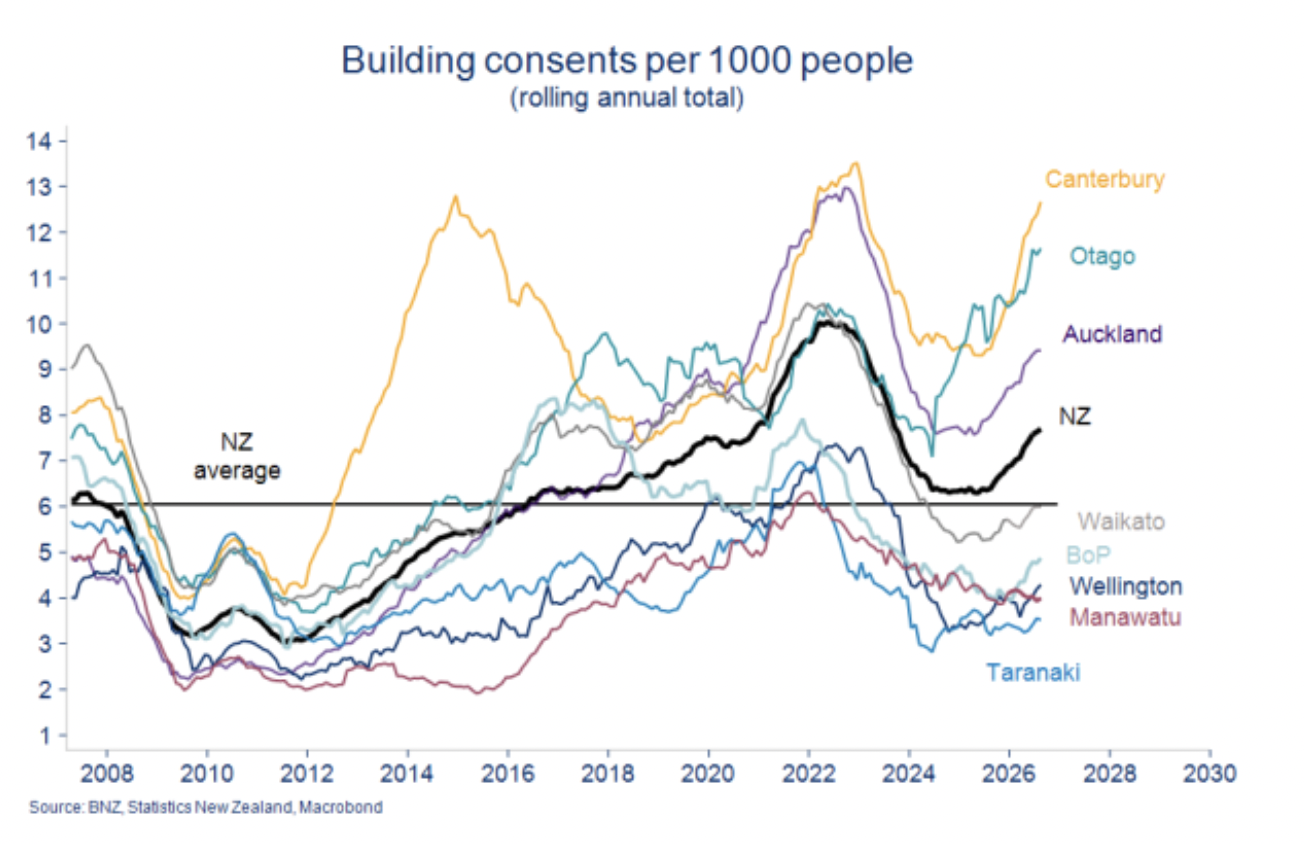
The other factors are optimism in the sector, as measured by the ANZ’s September business confidence survey, the apparent upturn in NZ’s economic cycle, which should take residential construction with it, and the raft of policy changes this government have made to make it cheaper, faster and easier to build houses. Things like the RMA reform, but so much more.
Overall, the BNZ is “expecting continued modest growth in activity over the next 9-12 months. But that is part of what we’ve assumed as a tepid overall uptrend.” So some growth in residential construction, but nothing startling.
What could that mean for investors? Continued increase in supply in many areas, which could weigh on prices. In other locations, where the growth in consents is more modest, if that’s paired with strong economic activity, it could mean more opportunity for capital growth, and/or to carry out your own development to meet local demand.
Definitely an indicator to keep an eye on post-election.
In the news this week
Member Benefits That Make a Difference
Local Community
Strong Advocacy
Education Access
Exclusive Discounts
Weekly Media Updates
Members-Only Resources
Current Projects

Related Posts

Weekly Media Links Mon 28 September 2026
Weekly Media LinksLabour’s decision to leave interest deductibility unchanged is still the big story for rental property owners,...

Weekly Media Links Mon 21 September 2026
Weekly Media LinksWhat a weekend! The 2026 NZPIF Property Investors Conference wrapped up in Tauranga with a packed programme of...
Weekly Media Links Mon 14 September 2026
Weekly Media LinksThis week, NZPIF takes its concerns and policy ideas directly to Housing Minister Chris Bishop, including tax...
Weekly Media Links Mon 7 September 2026
Weekly Media LinksSpring’s here, the election is less than 50 days away, and there’s still plenty we don’t know about what it could...

Weekly Media Links Mon 31 August 2026
Weekly Media LinksPlenty is happening in property this week. NZPIF takes concerns about missing bonds straight to the Associate Housing...

Webinar : Election 2026: what could the next government mean for property investors?
Election 2026: what could the next government mean for property investors? With the election approaching, housing and rental policy is firmly back...
As featured on