
Looking Back to 1976: A Lesson Today’s Housing Debate Shouldn’t Ignore
Every now and then you stumble across something that makes you stop and think.
At a recent NZ Property Investors’ Federation board meeting, our Vice President Kathryn brought along a collection of old property investor magazines for a bit of show and tell. Among them was a copy of The Landlord from September 1976. Flicking through its yellowed pages felt like opening a time capsule.
Except… it didn’t.
What struck me wasn’t how different the housing market looked 50 years ago. It was how familiar the conversation sounded.
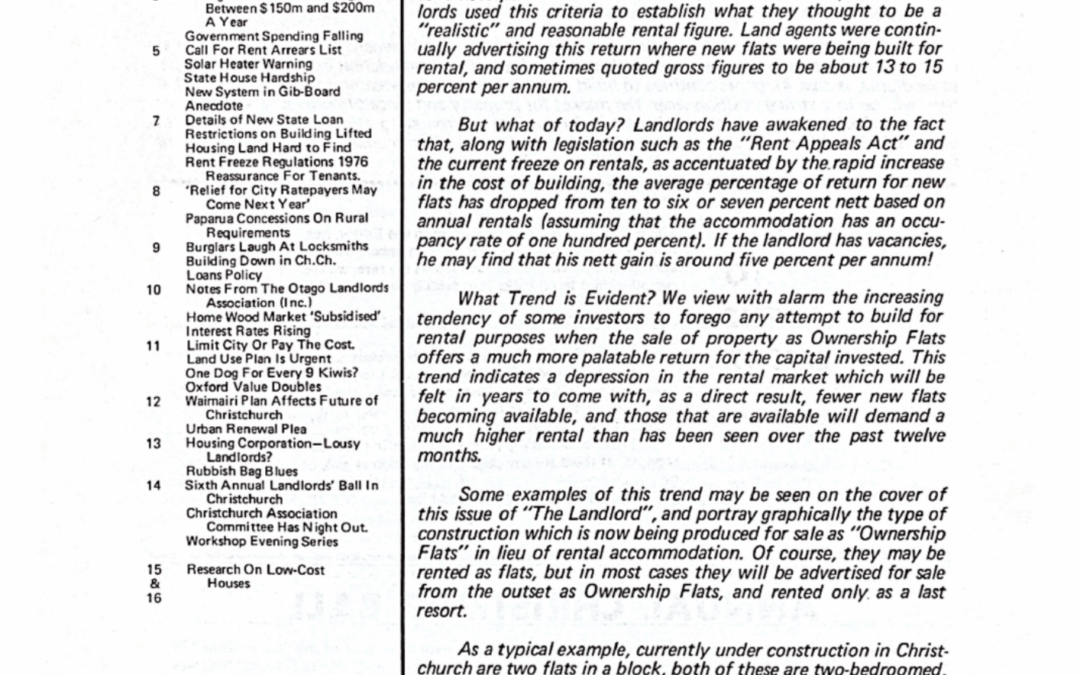
The editorial asked a simple question: “Are Rentals Realistic?” It argued that rising building costs and declining rental returns were making it increasingly unattractive to build rental housing.
Investors, it said, were instead choosing to sell properties as ownership flats because the financial return was significantly better.
The writer warned that this shift would reduce the supply of rental accommodation, creating shortages and eventually pushing rents higher.
Sound familiar?
Of course, the details are different today. In 1976, the editorial pointed to rent controls and rapidly rising construction costs. Today’s market has been shaped by a different mix of interest rates, tax policy, compliance costs, planning rules and economic pressures.
But the underlying principle hasn’t changed. Housing responds to incentives.
If providing rental accommodation becomes less financially viable, fewer people choose to provide it. Investors don’t stop investing altogether. They simply put their money somewhere else.
That’s not ideology. It’s economics.
One of the more fascinating parts of the article is its financial example. It walks through the numbers for two newly built two-bedroom flats in Christchurch. After accounting for mortgage interest, rates and insurance, the landlord was left effectively operating at a net loss. The editorial concluded that the real financial incentive was no longer renting the properties out, but selling them instead.
Again, the numbers themselves belong to another era. A construction cost of $13,000 and weekly rents of $32 feel almost impossible to imagine today.
But the calculation behind them is timeless.
If rental housing doesn’t stack up financially, the supply of rental housing is likely to suffer. That’s an important reminder as New Zealand continues to debate housing policy. Whether you’re talking about tax settings, regulation, planning reform or investment incentives, it’s worth remembering that every policy changes behaviour. Good intentions alone don’t build houses.
Looking back through a 50-year-old magazine isn’t about claiming history repeats itself exactly. Every generation faces its own economic conditions and policy challenges.
What history can do, though, is remind us that some lessons keep resurfacing. Fifty years ago, property investors were warning that squeezing the economics of rental housing would eventually reduce supply and put pressure on rents.
It’s a conversation we’re still having today.
Perhaps that’s the most remarkable part of all.
– Matt Ball.