
Look past the headlines: lessons for long-term investors from PMG
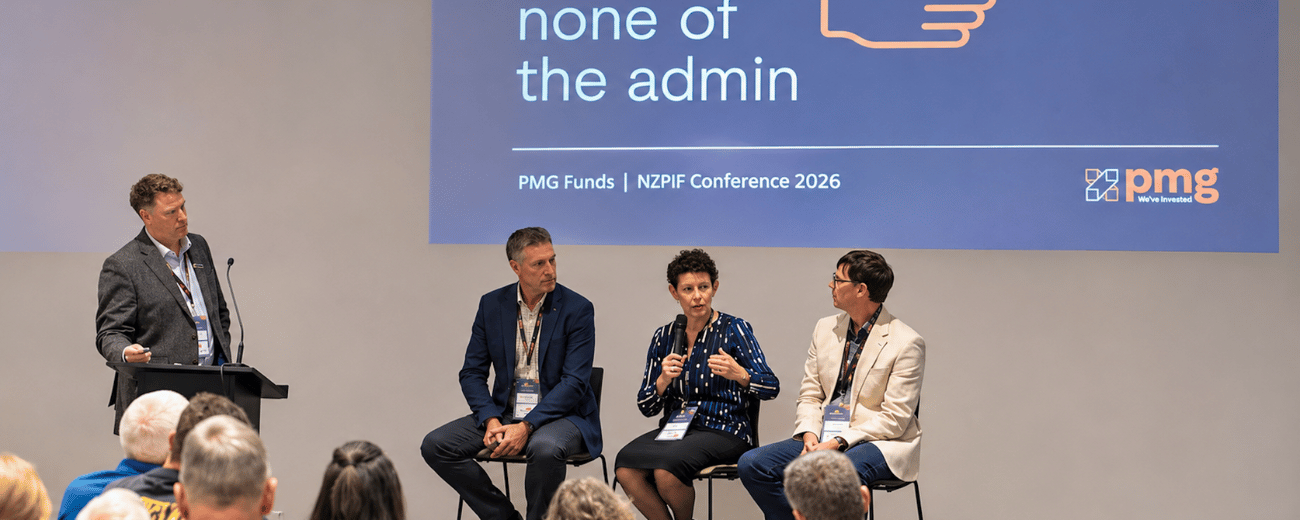
Markets have always been uncertain. What's causing the uncertainty changes. At the 2026 NZPIF Property Investors’ Conference, PMG explored why long-term thinking, sound fundamentals and perspective matter more than the latest headlines.
 ×

the next headline.
Look past the headlines
There's always going to be something
One of the speakers has worked in investment markets for more than 20 years and made the point that, throughout that entire time, there has always been something that looked worrying.
And when you're right in the middle of it, whatever is happening can feel enormous. It's much easier with hindsight to look back at previous crises and see them as another period the market eventually moved through.
That's not an argument for ignoring risk. But there is a difference between understanding what's happening and allowing every new development to change your investment plans.
As one of the PMG speakers put it, if you become too wrapped up in everything that could go wrong, you can end up doing nothing at all.
That was probably one of the simplest points of the session, and one of the better ones.
Social media isn't exactly helping
A few people in the room could probably relate when the conversation turned to phones, social media and the way headlines now drive behaviour.
We see a headline about a proposed property policy and immediately wonder what it means for our portfolio. Something happens overseas and markets react before most of us have even worked out what's actually happened.
Sometimes you get underneath the headline and discover the real-world impact is nowhere near as dramatic as it first sounded.
So the suggestion wasn't to stop reading the news. Just give it a bit of perspective before making decisions with your money.
Interest rates might be the bigger change
This was where the discussion became particularly relevant for property investors.
Most people investing today have spent much of their adult lives in a fairly unusual period. From the late 1980s onwards, interest rates broadly trended down.
When economies stumbled, central banks could cut rates. Borrowing became cheaper, activity picked up and asset prices often got another push.
After a few decades of that, it's pretty easy to assume that's simply how the world works.
PMG's view was that we need to be careful about making that assumption.
The long decline in interest rates may be behind us. That doesn't mean rates are heading relentlessly upwards either, but we may spend much more time in an environment where borrowing costs move around without returning to the ultra-low levels investors became used to.
And if that's the case, waiting for cheaper debt to rescue an investment isn't much of a strategy.
Back to the boring stuff: does it actually stack up?
Which brings things back to cash flow. If borrowing costs don't keep falling, the numbers underneath an investment become even more important.
What income is it producing? What does it cost to hold? What happens if interest rates stay where they are for longer than expected? Is there enough room for maintenance, vacancies and the inevitable expense you didn't see coming?
None of this is particularly exciting. It's also the stuff that matters.
An investment that works because the fundamentals are sound gives you a lot more breathing room than one that needs interest rates to fall, rents to rise and the market to move in your favour.
Housing policy doesn't happen in a vacuum
Government policy came into the conversation too, particularly around changes that affect residential property investors.
This is something NZPIF has been raising consistently with government: changing the rules for rental property doesn't only affect the person who owns the house.
If a policy makes owning a rental considerably less attractive, some investors will sell or decide not to buy. If that reduces the number of rental properties available, tenants feel the effects too.
That doesn't mean governments shouldn't make changes. It means the flow-on effects need to be thought through properly.
We've already seen how quickly changes in costs and regulation can feed through into decisions about whether people stay in the rental market.
A bit of perspective from across the Tasman
There was a nice moment when one of the speakers talked about a recent property conference in Sydney.
The opening speakers had covered geopolitics and the Australian and New Zealand economies and, by the end of it, the outlook was starting to feel a little grim.
Then one of the speakers finished with a question: with all the issues we have, where else in the world would you rather be? It landed.
New Zealand has plenty of problems to solve, and nobody was suggesting otherwise. But if you're spending every day reading economic and property news, it's surprisingly easy to come away thinking everything is falling apart.
Sometimes a little perspective helps.
Think longer than the next headline
If there was a common thread running through the two PMG sessions, this was probably it.
Know what you're trying to achieve and invest with that in mind. Keep an eye on what's changing, particularly things like borrowing costs that genuinely affect the numbers, but don't let every headline knock you off course.
Property will have good years and bad ones. Governments will change. Interest rates will move. Something happening on the other side of the world will periodically give everyone a fright.
Twenty years from now, there will almost certainly still be something to worry about.
For long-term investors, knowing what deserves your attention, and what is mostly noise, may be half the battle.
Want to know more about PMG?
PMG Funds manages $1billion assets under management and around $650 million in funds under management on behalf of more than 4,500 direct and indirect investors, invested across New Zealand commercial property.
Find out more about PMG and its current investment opportunities.
Find out more about PMGThis article brings together some of the key themes and discussion from two PMG sessions at the 2026 NZPIF Property Investors’ Conference in Tauranga. It reflects the speakers' views and is not financial advice.